I gave eight Claude and GPT models the same scrambled Rubik’s cube and let each one solve it live, one move at a time. Three solved it. Claude Opus 5.5 needed 55 moves, GPT-6.2 Sol needed 93, and GPT-6.2 Astra finished on move 100 — the last one its budget allowed.
The scramble was six moves deep: L2 F L' U F' D2. Every model had the same limit of 100 moves or 10 minutes of model time, whichever came first. The two model families that solved it played in opposite ways. Opus thought hard and made fewer moves; Astra barely thought and moved constantly.
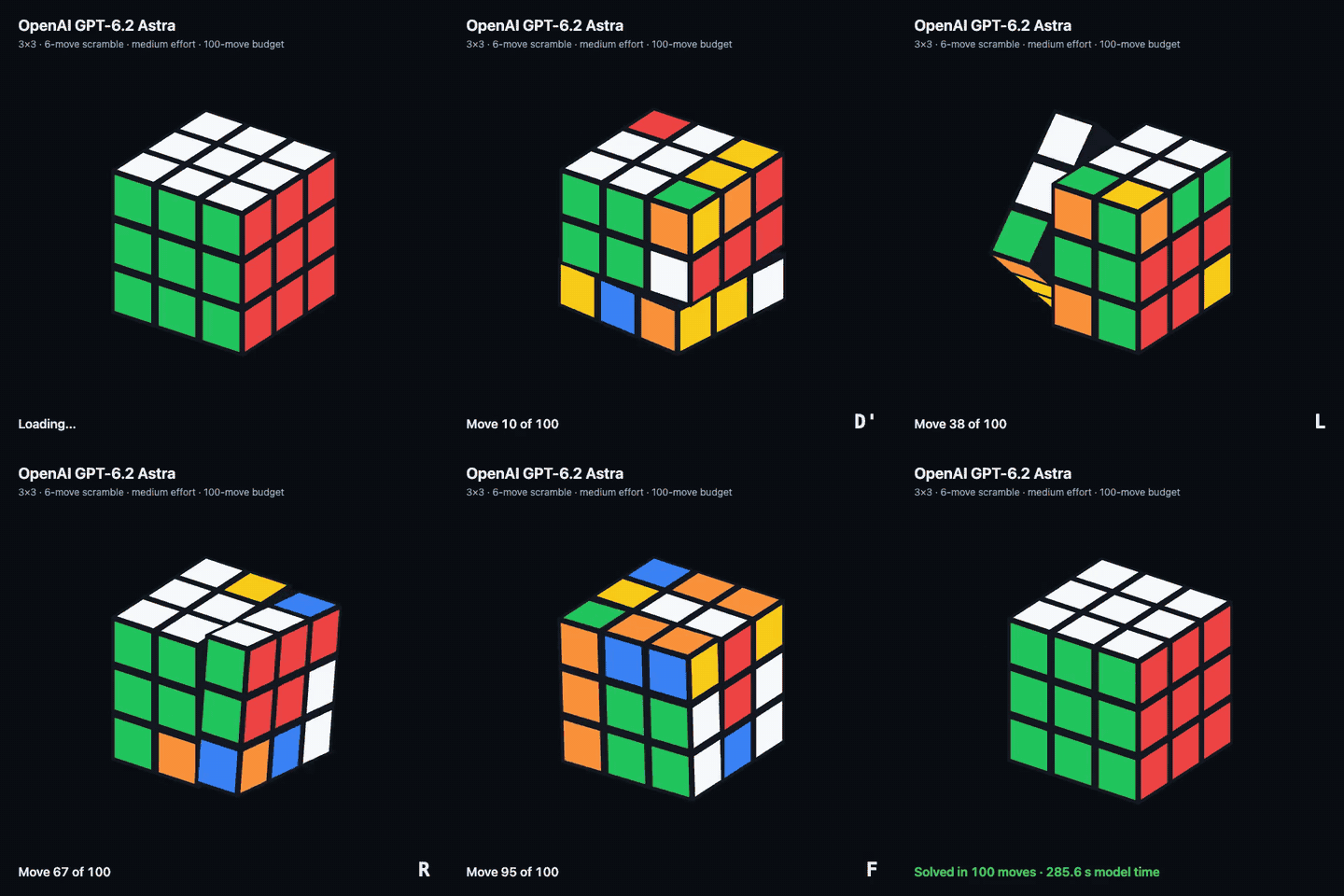
GPT-6.2 Astra’s full solve, replayed from its move log: the 6-move scramble, then its 100 moves. MP4 version.
TL;DR
- A solve cost $0.43 with GPT-6.2 Sol, $1.27 with GPT-6.2 Astra, and $1.45 with Claude Opus 5.5. Astra cost three times as much as Sol because 73% of its bill was re-reading the cached conversation on each of its 100 moves.
- GPT models moved fast with little reasoning. Astra used 1,699 reasoning tokens across its whole 100-move solve. Claude models reasoned hard before moving, and Haiku 5.5 averaged about 2,000 reasoning tokens per move.
- The time limit changed the winners. With 5 minutes, only Astra solved it, and Opus made 9 moves. With 10 minutes, Opus solved it.
- Two Claude models quit on their own in the main run: Sonnet 5.5 after 65 moves and Haiku 5.5 after 38, each with moves left to spend.
Why a Rubik’s cube
The Rubik’s cube is a 3D puzzle that Hungarian architecture professor Ernő Rubik invented in 1974. A 3×3 cube has about 43 quintillion arrangements, and in 2010 researchers proved that any of them can be solved in 20 moves or fewer.
That makes the cube a useful model test: the state space is far too large to memorize, every move can be checked by a program, and there is one solved pattern, in any orientation. Scramble depth works as a difficulty dial. To solve it, a model has to picture how a turn moves pieces in three dimensions, keep track of the cube over dozens of moves, and plan ahead, which are the skills CubeBench, from a team including Princeton researchers, set out to isolate. In CubeBench’s easiest setting, where agents see the full cube as text, the best average pass rate was 37.5%.
Purpose-built systems solved the cube years ago. DeepCubeA solved every test scramble in 2019, and OpenAI trained a robot hand to carry out a solve on a physical cube the same year, with a classical solver choosing the moves. A general-purpose language model gets no such training, so the cube shows how well it reasons through an unfamiliar spatial problem.
The RubiksBench leaderboard asks models for every move in one reply, with no tools. In its November 17 update, only 14 of 36 models solved even one of ten 6-move cubes, and Claude Opus 5.5 at low effort solved 5 of 10. My test differs: models move one at a time, see the result of every move, and play against a clock.
How the test works
Each model plays in one ongoing conversation with two tools. get_state returns the current cube for free. make_move applies exactly one move, such as R, U', or F2, and returns the updated cube. A legal move counts against the budget even if it makes the cube worse. The model never gets a hint, a solver, or the scramble sequence.
The model sees the cube as an unfolded net with color letters, plus a count of stickers matching their face center. This was the starting position for every model:
           UP (U)
           G G B
           O W W
           B W W

LEFT (L)   FRONT (F)  RIGHT (R)  BACK (B)
R B W      R G G      R B O      W Y Y
O O W      R G G      R R R      B B Y
G R R      B B Y      O O O      Y W W

           DOWN (D)
           Y Y G
           Y Y G
           O O B
All eight models ran at the same time on Amazon Bedrock, at medium reasoning effort, with prompt caching on. The rules tell each model it has a move budget and “a limited amount of thinking time,” without saying how much time. A browser animates each move in 3D as it arrives, and a separate cube engine replays the scramble plus each model’s moves to confirm every solve.
The results
Same scramble, 100 moves or 10 minutes, medium effort. Costs are estimates from published per-token rates; reasoning tokens are billed as output. The last column shows the same scramble with only 5 minutes.
| Model | Result | Moves | Model time | Reasoning tokens | Est. cost | With 5 minutes |
|---|---|---|---|---|---|---|
| Claude Opus 5.5 | Solved | 55 | 436 s | 28,241 | $1.45 | Out of time after 9 moves |
| GPT-6.2 Sol | Solved | 93 | 261 s | 8,692 | $0.43 | Gave up after 94 moves |
| GPT-6.2 Astra | Solved | 100 | 286 s | 1,699 | $1.27 | Solved in 90 moves |
| GPT-6.1 Terra | Out of moves | 100 | 266 s | 6,791 | $0.26 | Out of moves |
| GPT-6 Luna | Out of moves | 100 | 266 s | 21,679 | $0.06 | Out of moves |
| Claude Fable 5.2 | Out of time | 55 | 600 s | 39,340 | $3.09 | Out of time after 17 moves |
| Claude Sonnet 5.5 | Gave up | 65 | 511 s | 45,939 | $1.11 | Out of time after 36 moves |
| Claude Haiku 5.5 | Gave up | 38 | 444 s | 76,878 | $0.12 | Gave up after 17 moves |
Opus 5.5’s result is from its second attempt on the same scramble; the first was interrupted after 11 moves. Every other model had one attempt.
GPT-6.2 Astra was the only model to solve the cube in both runs. Its 5-minute solve used the wide turn Rw2 and finished with the whole cube turned over — white on the bottom — which still counts, because every face is one color.
How each family played
The GPT models treated the cube as a fast feedback loop. GPT-6.2 Astra averaged 17 reasoning tokens per move and leaned on each returned state to correct course. GPT-6.2 Sol averaged 93. All four GPT models finished in under 5 minutes of model time, and all four used most or all of their 100 moves.
The Claude models planned before moving. In its solve, Opus 5.5 spent 6,060 reasoning tokens before its first move, then about 410 per move after that. It found the shortest solve of the three, 55 moves, and its first move D2 undid the scramble’s last move. Haiku 5.5 reasoned more than any other model, 76,878 tokens across 38 moves, and still gave up.
I read that split as the reason the 5-minute run looked so different. A time limit favors models that move fast and fix mistakes as they go; a move limit favors models that plan. With 5 minutes, Opus made only 9 moves: its first reply spent 87 of its 300 seconds reaching the 8,000-token reply cap without moving, and another reply took 86 seconds. With 10 minutes, it solved. Extra time did not rescue Fable 5.2: it made 17 moves in 5 minutes and 55 in 10, and ran out of time both times.
Near misses and give-ups
GPT-6.2 Sol came within a few pieces in both runs. At move 72 of the run it solved, it reported “The bottom two layers and all four top edges are solved; only the four top corners remain,” and the replay confirms 44 of 54 stickers matching. In the 5-minute run it stopped at 94 moves with “the four yellow corners remain unsolved,” at 43 of 54. GPT-6.1 Terra ran out of moves in both runs; in the 5-minute run it ended with “Two corners remain twisted,” at 48 of 54. GPT-6 Luna used all 100 moves both times without closing the gap.
Two Claude models stopped by choice. The rules tell each model that the session ends if it replies without calling a tool, and the server sends one reminder first. In the main run, Sonnet 5.5 stopped after 65 moves, saying “the up-left cross edge is wrong,” and Haiku 5.5 stopped after 38.
On a different 6-move scramble (B' D L2 D2 L U') with a 50-move, 2-minute budget, Sonnet 5.5’s very first reply was: “The scramble is too deep for me to solve by hand within 50 moves.” It then tried a few moves, said it was stopping, and ended with 11 moves used on a scramble that needed six.
What it cost
The eight-model run cost about $8.23 in estimated model charges, including both Opus attempts. Prompt caching kept the total down. In the 10-minute run, every completed attempt read at least 96% of its input tokens from cache, because each move resends the growing conversation. That re-reading is also where most of the money goes for a fast mover: $0.93 of Astra’s $1.27 was cache reads and $0.16 was output. For Opus 5.5, output was the largest share, $0.68 of $1.45.
Caching works differently by model family. GPT models on Bedrock cache automatically. Claude on Bedrock caches only at checkpoints the request marks, per the Bedrock prompt caching guide, and every Claude request in this test marks them. Without checkpoints, each Claude move re-pays for the whole conversation: an uncached Claude Fable 5.2 attempt cost $4.66 for 25 moves. A cost comparison that leaves Claude uncached mostly measures the setup.
What this test cannot show
- One attempt per model on one scramble (two for Opus 5.5).
- Medium effort only. “Medium” is a different control on Claude and on GPT, so it does not mean equal thinking budgets, and I have not measured whether higher effort helps one family more than the other.
- Each reply was capped at 8,000 output tokens, including reasoning. Every Claude model hit the cap at least once; no GPT reply did. A capped reply makes no move and draws the same “session ends” reminder as a deliberate stop.
- The models were not told the time limit, so none could pace itself against the clock.
- GPT-6.2 Sol and Astra had no published AWS rate yet. Their costs use OpenAI’s list price plus 10%, because Bedrock’s cross-region inference guide puts US-only routing about 10% above global routing.
- 3×3 only. The model reads a text net and never sees the 3D view.
Open thread
I still can’t tell how much of each result is the model and how much is luck on this scramble. Astra has now solved three scrambles, including this one on its last allowed move, and Sol both solved and gave up on the same cube. The next run is five fresh scrambles per model at two effort levels, with the time limit stated in the rules, so a solve rate replaces a single yes or no.